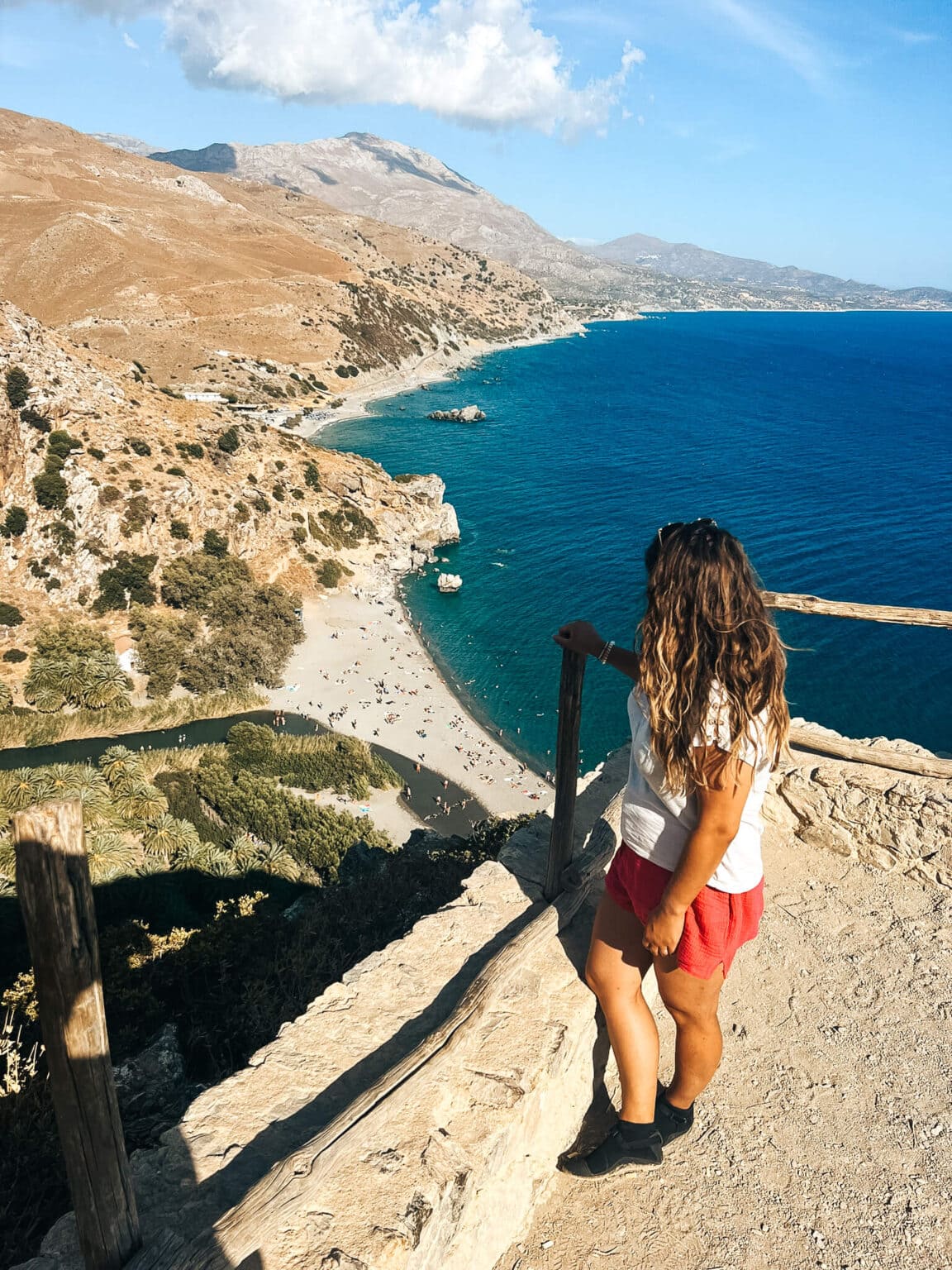
Planning a 7 days in Crete itinerary sounds simple… until you realise how big the island actually is.
After spending three weeks in Crete, moving between places like Chania and Bali, I quickly understood that trying to see everything from one base just doesn’t work.
This is actually the route I recommended to my sister when she was planning her trip — based on what I experienced myself, what I’d do again without hesitation, and what I’d skip next time.
It focuses on the west and central part of the island, uses two bases, and mixes the big highlights with a few places that ended up being some of my favourite moments.
If you want a week in Crete that feels full but not rushed, this is the itinerary I’d follow.

Day 1: Arrive Chania — old town, port, first dinner
Day 2: Balos lagoon by boat from Kissamos
Day 3: Slow inland loop — Vamos, Georgiopolis, Kournas Lake
Day 4: Loutro — drive to Hora Sfakion, ferry in
Day 5: Elafonissi beach (last Chania-based day) OR Falassarna
Day 6: Moving day — bougatsa in Chania, Knossos, arrive in Bali
Day 7: Rethymnon — full day in the old town, dinner at Avli
Day 8 (optional extension): Samaria Gorge OR beach day at Bali/Skaleta
Two bases: Chania (nights 1–5), Bali (nights 6–7+). Car essential throughout.
Driving reality: Days 1–5 are western Crete focused. Day 6 is a moving day with a major stop (Knossos, ~2h from Chania). Day 7 is easy — Rethymnon is just 30 minutes from Bali.

Planning a trip to Crete ?
I spent 3 weeks exploring every corner of the island so you don’t have to guess. My Crete map and guide gives you 40+ handpicked spots with my personal notes, photos and honest tips — the best beaches, restaurants and hidden gems, all in one place.
Grab your copy and travel like a local.

I’m Ersilia – architect and travel lover based in France
I help English-speaking travelers plan meaningful trips across Europe, mixing iconic sights with hidden gems and authentic local experiences, all based on places I’ve personally explored.
✨ Browse my Europe guides
✨ Or discover my France travel resources for deeper local insight
Want me to plan your trip? Details here
Why Two Bases?

Because Crete is 260km long and trying to drive the whole island from one base means spending half your holiday on the road.
Chania is the obvious first base
Chania is the most beautiful city and the best place to start exploring the west.
If you’re still deciding between Chania and Heraklion, read my comparison guide. But this itinerary won’t work if you choose Heraklion as a base.
For the second base, we chose Bali. It sits roughly halfway between Rethymnon and Heraklion, which puts you within reach of both.
It also has its own charm: a small village that has become a resort town, built on slopes above a series of pretty coves, with a seafront promenade lined with restaurants.
Bali vs Rethymnon — which second base?
- Choose Bali if you want easy swimming coves, a relaxed, low-key vibe, and don’t mind slopes. Good value accommodation, good for winding down after a packed first half.
- Choose Rethymnon if you want old-town charm as your base, flat walkability, and better dining options on your doorstep. It’s 30 minutes from Bali and a genuinely beautiful city — if you have a chance to stay in the old town itself, do it.
We chose Bali for the price and the pool. If I did it again, I might choose Rethymnon.
Days 1–4: Chania Base

These four days are covered in full detail in the 5-day Crete itinerary. Here’s the condensed version so you have the shape of the week:
Day 1 — Chania old town: The Venetian port at sunset. Leather street (Skrydlof). Zampeliu Street artisan boutiques. The Folklore Museum — hidden courtyard, embroidery, the woman whose work you’ll wish you’d bought. Dinner at Dimos in the port, recommended by people who’ve eaten here every year for two decades.
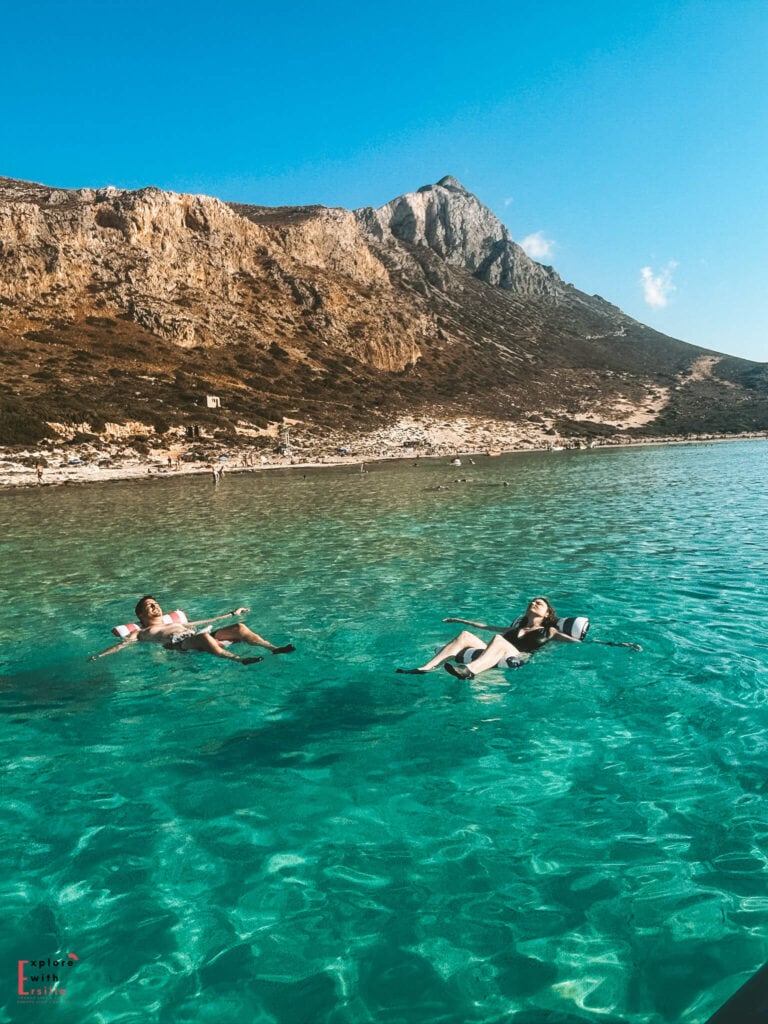
Day 2 — Balos: Morning boat from Kissamos. The Gramvoussa fortress stop. The Balos lagoon — shallow, turquoise, crushed-shell sand. Dinner at Gramvousa restaurant (book well ahead, wait an hour, worth it).
Day 3 — Slow inland loop: Vamos (20-minute stop, charming but small). Georgiopolis and the tiny chapel on the rocks. Monastery Agios Georgios — no shade, go late afternoon, completely alone, one of the most atmospheric places we found by accident. Kournas Lake and the pedalo cars.
Day 4 — Loutro: Drive to Hora Sfakion, about two hours south on beautiful mountain roads. Take the ferry to Loutro (around €6). Spend the afternoon in one of Crete’s most peaceful villages — no roads, no cars, and the deepest blue sea. Have a drink at Castella Veranda. Avoid eating at Taverna Limani (trust me). Take the last ferry back and spend the drive home wondering why you didn’t stay overnight.

Balos & Gramvousa boat trip
The morning boat from Kissamos stops at the Venetian fortress of Gramvousa, then drops you at the lagoon before the midday crowds arrive. Book a few days ahead in July and August.
Day 5: Elafonissi — Last Day in the West

Your last day is based in Chania, and the best use of it is the beach that’s been on your radar since you started planning this trip.
Elafonissi is 76km southwest — about 1h45 on a road that gets increasingly beautiful as it climbs through the White Mountains and descends to the coast.
Leave by 8am. Car parks fill by 10am in summer. By 11am it’s crowded.
The water is extraordinary — shallow, turquoise, warm from June onwards.
The sand has a pinkish tint from crushed shells; look for the most vivid colour at the edges of the lagoon rather than the main beach. Wade across the sandbar to the quieter island side.
Bring everything: food, water, sunscreen. The sand gets ferociously hot, so water shoes prevent the undignified hopping-around-in-agony we witnessed others endure. The kiosks are basic.
Leave by 2–3pm. Back in Chania to pack, sleep well, and prepare for the moving day tomorrow.
Plan B if it’s too windy or crowded: head to Falassarna instead (45 minutes north on the same coastline) — wider beach, same extraordinary water, significantly fewer people. Honestly, comparable beauty with a fraction of the fuss.

Plan C: Red Havana Beach Club (redhavana.com) near Chania — pay for drinks, sunbeds included. Prices are on the higher side (approx. €7 for a soft drink, €15 for a sandwich or salad), but the setting is beautiful, there’s a pool section as well as a beach, and my sister and I got massages there that were genuinely the best of the trip. Looks fancier than it costs. Book sunbeds on their website.
Day 6: Moving Day — Bougatsa, Knossos, Bali

Moving days are best treated as trip days in themselves, not just transfers.
Moving day checklist: pack your day bag the night before (hat, water, sunscreen). Leave main luggage in the car. Eat bougatsa early. Aim to be at Knossos by opening time.
Morning: Bougatsa in Chania

Before leaving, go to Bougatsa Iordanis one more time.
Creamy custard in phyllo, icing sugar and cinnamon, around €3, a queue of locals that tells you everything. It’s the most Cretan breakfast there is. Leaving Chania without this is a mistake.
Sit somewhere nearby and eat it slowly. This is your goodbye to western Crete.
Mid-Morning: Knossos

Knossos is about 5km south of Heraklion — roughly an hour from Chania, making it a natural moving-day stop. (Yes, you will drive for longer but you would be driving either way!)
Hire a guide. This was the single best money we spent in all of Crete. Not because the site is confusing — it’s actually well laid out — but because a good guide transforms it from impressive ruins into a living world.
Our guide brought the history, legends, and mythology to life in a way no signboard in the hot sun could. I was reading Circe then, a novel full of Greek mythology, and her stories combined with the book made the experience almost cinematic. Standing in the ruins where the Minotaur myth began, with someone telling the story, was one of my best travel experiences.

Knossos with a private guide
Hiring a guide was the single best money we spent in all of Crete. The history, legends and mythology come to life in a way no signboard in the hot sun can.
Knossos reminded me of Pompeii — walking through a real ancient world. The difference is that in Pompeii the buildings were preserved by the eruption; here, much of what you see is reconstruction. Some people call it kitsch. I call it fascinating. Being able to see how life actually looked nearly 4,000 years ago — the red columns, the throne room, the multi-storey buildings — is worth the reconstructions.
Entry: around €15 (€8 reduced); combined ticket with the Archaeological Museum €20. Typically opens around 8am — closing time varies seasonally, check before you go. Arrive at opening to beat tour groups and the worst heat. Allow at least 2 hours, more with a guide.
Practical note: the site is fully exposed. Hat, sunscreen, water — non-negotiable.
Afternoon: Drive to Bali

From Knossos, Bali is about 45 minutes west on the north coast road. Arrive mid-afternoon — enough time to check in, find the nearest cove, swim, and watch the light change over the water.
Bali: What to Expect

Bali is a pretty and intimate, built on slopes above a series of small coves. It has a beautiful seafront promenade with restaurants. Hasn’t been overrun yet.
One honest caveat: everything is on slopes. Getting from your hotel to the seafront at night means walking stairs and hills in the dark. If you have mobility concerns, choose Rethymnon instead. It has a flat old town, great restaurants, and is just 30 minutes away.

Where we stayed: the Gorgona Hotel — a small taverna-hotel with a private pool and an authentic local feel. Cheap and good value.
But, I have two honest criticisms: the breakfast was surprisingly poor quality for Greece, and the staff were pleasant but not warm — no recommendations, no suggestions, nothing of the Greek hospitality you’ve experienced everywhere else.
That said: the taverna food at dinner was the best we ate in Bali. Go for dinner even if you don’t stay here.
Evening
Walk the seafront promenade. Find a table with a sea view. Long dinner, early night. Tomorrow is Rethymnon.
Day 7: Rethymnon

I loved Rethymnon more than I expected. More than Chania, in some ways — though I’d say that quietly, because Chania fans are passionate.
The old town here feels like it covers more ground than Chania’s. The streets are beautiful and colourful. Venetian architecture, Ottoman minarets, a harbour that echoes Chania’s but smaller and somehow more intimate. It feels more local, less polished for tourists.
Rethymnon is just 30 minutes from Bali, a perfect day trip distance.
Morning: Walking the Old Town

Start at the Venetian harbour. It is smaller than Chania’s, with the same layered architectural history. Walk along the waterfront and into the old town.
There’s a street I still think about — I don’t remember the name, so if you find it, tell me. There was a woman artist painting outdoors, and with the perspective of the old tower behind her, the whole scene looked like a painting itsel.
Right next to her, on the street in front, a colourful restaurant with an outdoor patio. We didn’t eat there. I still wish we had.
The Fontaine Rimondi (1626) — a Venetian fountain with three lion heads still flowing. The water has been running here for four hundred years.
The Porta Guora — the only remaining gate of the Venetian city walls, with the Lion of Saint Mark carved above it. The symbol of Venice, in the middle of a Greek city. That’s Crete in one image.
Mid-Morning: The Venetian Fortress

The Venetian Fortress (around €4 — verify current hours before visiting) dominates the hill above the city. Enormous, star-shaped, sweeping views over the city, the sea, and the mountains.
Inside: the Mosque of Sultan Bin Ibrahim with its magnificent vaulted dome. The light through the interior, the acoustics — they use it for concerts, which makes complete sense once you’re standing inside it.
A practical note: there is very little shade on the fortress walls. Small electric cars are available for visitors with limited mobility, but walking in the summer heat is very challenging. Try to visit in the morning.
Afternoon: The Archaeological Museum

The Archaeological Museum of Rethymnon (around €2 — verify current hours and prices) — housed in a Venetian church, with a collection spanning the Minoan to the Byzantine periods.
Two highlights: a very early Neolithic figurine estimated at around 9,000 years old, and fossils of the dwarf hippos and elephants that were endemic to Crete before humans arrived. Those fossils alone make it worth the hour.
Evening: Avli

If you eat at one restaurant this entire trip, make it Avli in Rethymnon.
We ate in a small stone courtyard with clay pots of plants climbing the walls, candlelight, the sound of the city fading outside.
The chef came to our table personally and recommended what to eat. My husband had a lamb dish that was simply, quietly perfect.
Avli is also a small hotel, and guests get breakfast served in this same courtyard every morning. When the chef came to talk with us, I was genuinely envious of the people upstairs.
It’s in the old town. Book ahead — this is not a walk-in place. Budget €35–50/person with wine.
Day 8 (Optional Extension): Choose Your Ending

If you have an extra day — or if you want to swap one of the earlier days for this — two options:
Option A: Samaria Gorge

The big hike. 16km descending from the White Mountains to the Libyan Sea. One of Europe’s most celebrated gorge walks. Hard on the knees. Extraordinary on the eyes.
Book a guided tour from your hotel. The guide keeps you on schedule for the critical ferry back, and helps coordinate logistics at the end of the gorge, which can be genuinely stressful when you’re exhausted and hundreds of other hikers are competing for the same boat. Note that ferry coordination varies by operator — check what’s included when booking.
From Bali, the pickup will be early (5–6am). The bus to the trailhead at Xyloskalo takes about 1.5–2 hours.
What to know:
- Start at 1,230m, finish at sea level over 16km of descent
- The highlight: the Iron Gates near the end — walls just 3.5m apart, rising 300m above you
- Bring snacks; don’t count on buying food inside the gorge. Water points exist along the route but bring backup
- Proper hiking shoes with ankle support — not trainers, not sandals
- Keep your ticket; you hand it in at the exit so rangers know everyone got out. Rescue inside involves donkeys. Really.
Afterwards: swim at Agia Roumeli, take the ferry to Hora Sfakion, then take the bus back. Bring a change of clothes.
Samaria Gorge guided tour
Hotel pickup, the bus to Xyloskalo, and a guide who keeps you on schedule for the last ferry from Agia Roumeli. The easiest way to do the gorge without worrying about logistics.
The route, the ferry times and what to pack are all in my full Samaria Gorge guide.
Option B: Beach Day at Bali or Skaleta
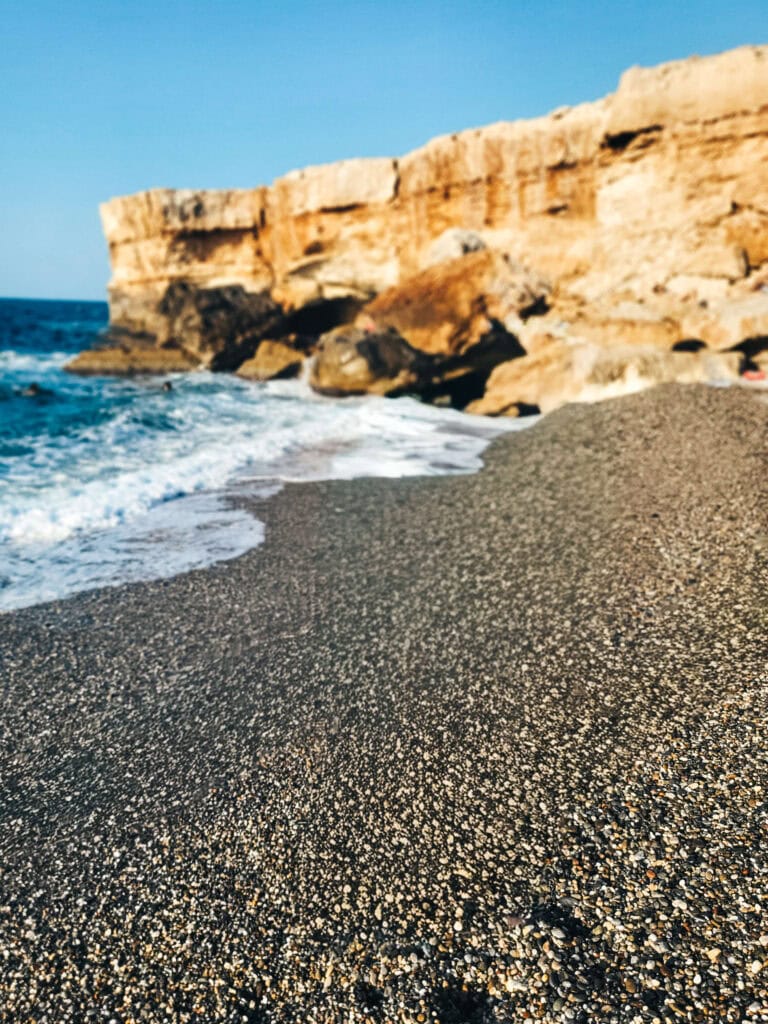
Permission to do nothing.
The Bali coves are small, calm, easy. Right there. Good swimming from June onwards.
Skaleta beach, between Bali and Rethymnon — small, nestled between cliffs, one of my personal favourites in Crete despite the fact that on our day there the waves made swimming impossible. The surrounding cliffs give it a sheltered, secret feeling.
After the Samaria Gorge hike, we rewarded ourselves with a full day at Baboo Beach Club in Bali — and it was absolutely worth it. We rented a bed that came with food and champagne for €100 for the day, which honestly felt like great value.

The beach itself is small and tucked away, giving it a lovely secluded feel even when it gets a bit busy. We spent the day snorkelling and spotting fish, sipping champagne, and just completely switching off after all those kilometres on our feet. Money very well spent — the perfect recovery day!
What This Week Doesn’t Cover

Seven days gets you western and central Crete. The east — Spinalonga, Elounda, Agios Nikolaos, Kato Zakros, Vai — is a whole other trip. If you have more time, my 3-week Crete itinerary adds a third base in the east and shows you the full island, and my complete guide to Crete covers everything else you need to plan.
Practical Details

The Two Bases
Chania (nights 1–5):
Best boutique options: Serenissima (from ~€170), Ionas Hotel (from ~€85), Casa Delfino (from ~€190). Group/family: villa on the slopes above the city.

Bali (nights 6–7):
Gorgona Hotel — private pool, authentic feel, cheap, excellent dinner taverna on site. Poor breakfast; staff pleasant but not warm.
Or consider Rethymnon old town instead — flat, walkable, better dining, 30 minutes from Bali’s beaches.
Getting Around

Car essential throughout. Budget €35–50/day in shoulder season, more in July–August. Book in advance.
Most demanding driving day: Day 4 (south coast to Hora Sfakion, 2 hours each way on mountain roads). Day 6 is straightforward — north coast highway most of the way.
Rough Budget Per Day

- Accommodation: €50–190/night depending on choice
- Meals: €15–25/person at traditional tavernas; €35–50 at Avli with wine
- Knossos entry: approx. €15/person (€20 combined with Archaeological Museum)
- Guided Samaria tour (transport + ferry coordination): approx. €35–50/person
- Balos boat: approx. €27 adult return
- Loutro ferry from Hora Sfakion: approx. €6 return
- Red Havana beach club: budget approx. €30–40/person for drinks + food
All prices approximate — verify locally as they change year to year.
Best Season
May–June and September–October — manageable crowds, warm sea, Samaria Gorge open for the season. July–August is beautiful but busy; book everything well in advance.