


Three days in Crete is not enough.
I want to be upfront so you know what to expect.
Crete is a 260km-long island with Minoan palaces, gorges that take a full day to hike, fishing villages only accessible by boat, and food so good you might want to cancel your flight home.
Three days is a taster. A very good taster.
The key isn’t to see everything (it’s impossible!) but to choose one part of the island and explore it well. For three days, that means focusing on western Crete, staying in Chania (this itinerary is not designed around Heraklion), and taking two day trips nearby.
This is the itinerary I’d recommend to my best friends visiting for the first time.

Quick version of the itinerary
- Day 1: Chania old town — port, leather street, Folklore Museum, dinner at Dimos
- Day 2: Balos lagoon by boat from Kissamos
- Day 3: Elafonissi or Falassarna beach — leave early, back by 2–3pm
Best season: May–June or September–October. Car needed for day trips (Day 1 is entirely on foot).
A quick note on the name: Chania is also written as Xania, La Canée, or Khaniá. It’s the same city. Locals use the X. Once you’re there, you’ll see why the name never settled on just one language — the city has belonged to many different civilizations, and its name reflects that history.

I’m Ersilia – architect and travel lover based in France
I help English-speaking travelers plan meaningful trips across Europe, mixing iconic sights with hidden gems and authentic local experiences, all based on places I’ve personally explored.
✨ Browse my Europe guides
✨ Or discover my France travel resources for deeper local insight
Want me to plan your trip? Details here
Why This Day Order
Day 2 is Balos, Day 3 is Elafonissi — and there’s a reason for that.
Balos means you have to stick to a ferry schedule from Kissamos (or to do some hiking), so it’s best to do it on a day when you’re rested and ready to leave on time.
Elafonissi is a longer drive, but you can go at your own pace since there’s no ferry. Save the more flexible trip for Day 3 in case you want to sleep in a bit.
This itinerary is not designed to show you all of Crete, it’s more about showing you why Crete is worth the visit.
Where to Stay
As a couple, Chania’s old town has some of the best boutique hotels in Greece.
Three that consistently come up in both research and recommendations:
- Serenissima — a renovated Venetian mansion with stone walls, candlelit niches, and a rooftop terrace. Doubles from around €170 with breakfast. If you want romantic boutique vibes, this is the one I’d pick.
- Ionas Hotel — 9 rooms in a 16th-century building in the Splantzia quarter. Doubles from €85. Small and genuinely lovely.
- Casa Delfino — a 17th-century mansion with a mosaic courtyard, hammam, and spa. From €190. The full splurge.
I didn’t stay in these myself because we rented a villa for a group trip, but they’re often praised for their location and service.


If you’re traveling as a group or family, consider renting a villa outside town.
We stayed in one on a slope above Chania with 4 bedrooms, 3 bathrooms, a private pool, and modern amenities.
The view was so stunning it made us stop talking when we arrived.
For a group of 8, it’s great value. Look for rentals by filtering “Chania countryside.”
This is the villa that we rented
On a budget?
Cocoon City Hostel (Kydonias 145) is modern and well-run.
Dorm beds start at €18, private rooms from €40.
It’s better than most hostels anywhere.

How to get around Crete in only 3 days
Day 1 is entirely on foot — Chania’s old town is made for walking and you won’t need anything else.
But Day 2 and Day 3 are a different story.
Balos means driving 40km west to Kissamos port to catch the early ferry. Elafonissi is 76km from Chania, on a road that gets progressively more dramatic as you climb into the White Mountains. The car parks fill by 10am. If you’re relying on a bus to get you there on time, you’re already losing the day.
With only three days, every hour counts. Book the car in advance — especially in May through September. Budget around €35–50 a day for a small car in shoulder season.
You can also book guided tours, if you choose not to drive, but those allow limited flexibility.
Day 1: Chania Old Town

Don’t rush to leave on your first day. Chania deserves a full slow morning.
Morning: The Venetian Port
Start early, before the tour groups show up.
Bougatsa Iordanis is great for a morning snack. It’s not really in the port, but you can start your day there and then walk your way back to the sea.
It opens early and closes around 2pm. This place is genuinely loved by locals.
You’ll often see a line of Cretans waiting for their bougatsa: creamy custard wrapped in phyllo, dusted with icing sugar and cinnamon. It costs about €3.
The place is simple—you might easily walk past it without noticing. They’ve been making it for about a century. Don’t miss it.

After your breakfast, walk down to the Venetian port and just soak it in for a while. Pastel-colored buildings reflect in the water. Fishing boats on one side, luxury yachts on the other.
This is one of the most architecturally interesting ports I’ve seen anywhere. Because Crete has been occupied by so many different civilisations — Minoans, Romans, Byzantines, Venetians, Ottomans, then finally Greece — the buildings around the port represent almost every one of them.

You can walk from one architectural world to another in ten minutes. It’s half Greek, half something else entirely, and completely its own thing.
Walk out to the lighthouse at the end of the breakwater. It’s farther than it looks, but the city views are worth it. The lighthouse dates back to the Egyptian period in the 19th century.
Yes, Egypt ruled Crete for a while — the history here is fascinating. The best time to visit is at sunset when the sky turns pink. Plan to come back in the evening.

Lunch
For lunch, Kouzina EPE (Daskalogianni 25) is where locals eat — modern Cretan dishes, blackboard menu, open kitchen, €5-10 per plate. Excellent quality-to-price ratio.
Afternoon: The Old Town on Foot
Skrydlof Street, known as the leather street, is a whole lane full of leather workshops and artisan shops. You’ll see real craftspeople working right in front of you. Great for bags, belts, and sandals. I bought a green bag that I love here!

Zampeliu Street is lined with small artisanal boutiques. I found one where they made pottery right in front of me, and you could buy it right there. I got a small cup for making milk foam for my morning coffee. It’s one of my favorite souvenirs — every morning it reminds me of Crete.


The Folklore Museum (Museum of Arts & Popular Traditions, Halidon 46b, €3 — check hours locally as they vary seasonally) is one that many people walk right past, which is a real shame. It’s in a small, easy-to-miss house.
But once you step into the patio, you find a hidden, peaceful corner full of plants.
I couldn’t understand why almost no one was there.
Inside, you’ll find a few rooms dedicated to embroidery and traditional Cretan interiors. There’s a woman doing hand embroidery on site, and you can buy her work. My sister bought a beautiful sunflower piece. I didn’t buy one, but I still think about it.


Fort Firkas at the western end of the harbour — the best-preserved Venetian fortification in Chania, free entry, good views from the top.
The Synagogue Etz Hayyim on Parodos Kondylaki is a 15th-century synagogue, the only one left in Crete. It was badly damaged in WWII and restored in 1999. It’s quiet, moving, and free with a small donation.


take a guided tour of the Old Town of Chania
A guided tour of the Old Town of Chania helps you understand the fascinating mix of Venetian, Ottoman, and Greek history hidden behind its beautiful streets and buildings.
A local guide can also show you secret corners, historic landmarks, and local stories you would likely miss if you explored on your own.
Option, if you feel you have time or if the weather is not with you : The Archaeological Museum or the Maritime Museum
The Archaeological Museum of Chania (around €6 — verify current hours and prices before visiting as these change seasonally) is housed inside a beautifully restored Venetian church. Better than most people expect.
It shows minoan finds from the western part of the island , like pottery, gold jewellery, clay tablets. Allow an hour to 90 minutes.
Evening: Dinner


Most harbour restaurants are tourist traps—mediocre food, high prices, but lovely views.
The exception — and this comes from friends who have been visiting Crete every single year for 20 years — is Dimos Restaurant, right in the port of Chania.
With blue chairs and wooden tables, it looks exactly like a traditional Greek taverna should.
The food is simple but genuinely good quality, and the view is the best you can get in the port: directly facing the lighthouse. A recommendation from people who have eaten everywhere in Chania over two decades carries real weight.

For a second night, try Taverna Michalis. It’s more refined and a bit pricier, but the food and wine are both exceptional.
For the splurge dinner of the trip: Taverna Michalis, right on the sea. People remember this meal for years. Book ahead.
The old town gets busy at night — part of the charm. Book restaurants in advance, especially for dinner in high season.
Day 2: Balos Lagoon
One of the most beautiful places in Greece. Go early or late in the afternoon.
How to get there

We went by speedboat and it was the right call.
You can also drive there if your car rental company allows it, or take a different route. I described all the ways to get to Balos in a separate guide.
Ferries run from Kissamos port (adult around €27, child €13 — check current schedules at the port or cretandailycruises.com as these change seasonally). Kissamos is about 40km west of Chania — leave by 8am for the early departure.
The crossing includes a stop at the Gramvoussa fortress on the headland above the lagoon — spectacular views, genuinely worth the stop.
The timing: midday (roughly 11am–4pm) is peak crowd time due to day boats and excursions from larger boats. Go on the morning ferry, arrive before the crowds, leave before it gets too busy. It works out almost perfectly if you catch the early boat.
We chose to go for sunset, so we actually went at 16pm! The flexibility of a smaller boat was priceless!
Plan B if boats are cancelled (wind can make crossings impossible, especially in shoulder season): drive to Falassarna instead. It’s a 25km south of Kissamos, long sandy beach, extraordinarily clear water, far less crowded than Elafonissi.
Have lunch in Kissamos on the way back, be back in Chania for sunset at the lighthouse.
The Lagoon Itself

The photos don’t lie. Shallow, turquoise water so clear and warm it feels more like floating in a bath.
No proper restaurants — bring food and plenty of water. Water shoes help on the coarser sections of beach.
On the Road to Kissamos


Keep your eyes open for a small church built directly into the rock (The Ioannis Prodromos Chapel in Kissamos) , right in front of the sea, somewhere along the western road.
We stumbled on it completely by accident. It was a serene, unexpected find.
Dinner: Gramvousa Restaurant


That evening we ate at Gramvousa restaurant — well-known in the area, named after the peninsula. Our host recommend it to us.
Book well in advance. Even with a reservation, we waited an hour in line. Inside, it was loud, crowded, chaotic.
The food was exceptional. The kitchen is open — you watch the staff cook in front of you. The design is old and real-feeling. I loved it.
Yes, it’s noisy and you might wait. But this is kind of typically Greek, isn’t it? You accept the chaos as part of the experience. It’s worth it.
Day 3: Elafonissi Or Falassarna
Your last day. The famous beach at the southwestern tip of the island.
The Drive

7At 6km from Chania, about 1h45, on a road that gets progressively more beautiful and more dramatic as you climb into the White Mountains and descend to the coast.
Leave by 8am. Car parks fill by 10am in summer. By 11am the beach is crowded.
The Beach
The beach is technically a small island connected to the mainland by a sandbar. At low tide you can wade across (ankle-deep) to the other side, which is slightly quieter.
The water is extraordinary — shallow, warm, turquoise. The sand has a pinkish tint from crushed shells; the colour is most vivid at the edges of the lagoon.
One practical warning: the sand gets incredibly hot in summer. It is genuinely painful to walk on barefoot. We saw people hopping around looking tortured. Bring water shoes. This is not optional advice.
Bring food, plenty of water, and sunscreen. The kiosks are basic.
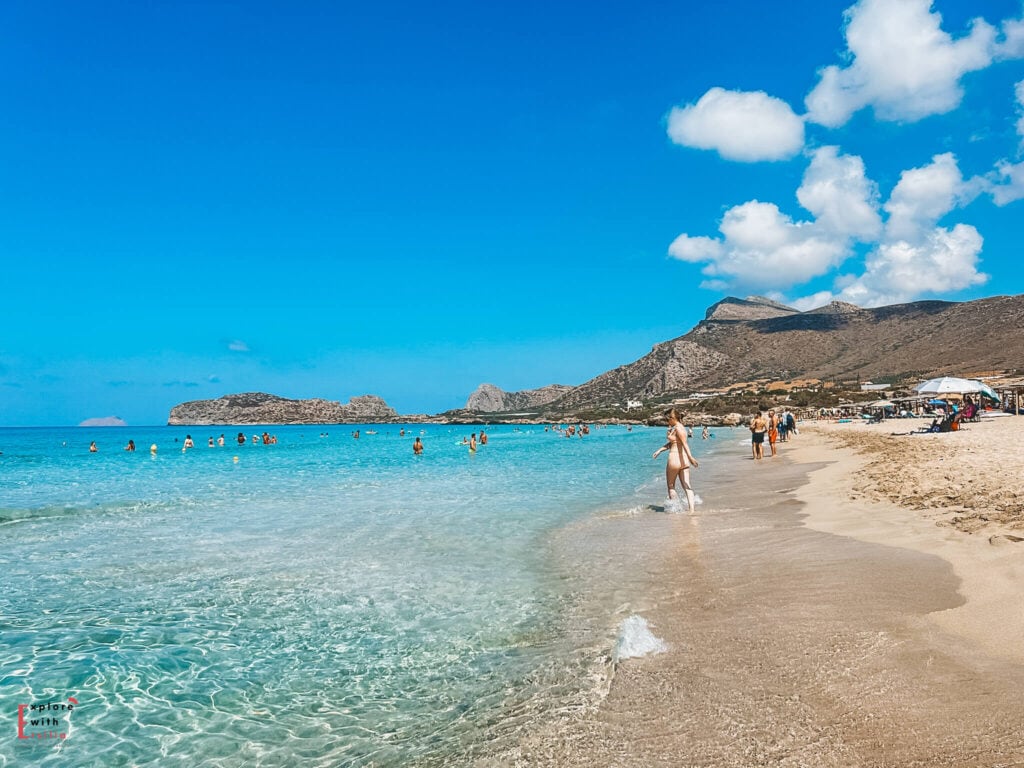
Plan B if it’s too crowded or windy: head to Falassarna instead (45 minutes north on the same coastline) — wider beach, same extraordinary water, significantly fewer people. Or turn it into a mountain village day: the drive through the White Mountains is beautiful enough to be its own experience.
The Return
Leave by 2–3pm. This way you will be back in Chania in time for a shower, a walk along the harbour at golden hour, and a final dinner.
Walk the port one more time after dinner. The lighthouse. The reflections on the water. The sound of the sea.
It’ll make you want to come back for longer.
(You should come back for longer.)
What to Skip for Three Days
The Samaria Gorge is a full-day commitment — 16km of hiking followed by a boat and bus back. Too much of your total time for a three-day trip. Save it for a longer visit →
Rethymnon is beautiful — honestly I loved it more than Chania in some ways, it feels more authentic and the old town covers more ground — but it’s 60km east, which is a half-day each way.
Knossos and the Archaeological Museum need a full day near Heraklion. Not practical for a western-Crete long weekend. Plan a longer trip →
Loutro — the most beautiful village on the south coast, only accessible by boat — is a trip I now wish I’d spent two full days in. For three days, there isn’t time. Read the full Loutro guide →

Planning a trip to Crete ?
I spent 3 weeks exploring every corner of the island so you don’t have to guess. My Crete map and guide gives you 40+ handpicked spots with my personal notes, photos and honest tips — the best beaches, restaurants and hidden gems, all in one place.
Grab your copy and travel like a local.
Practical Details
Getting to Chania
By plane: Chania airport (CHQ) receives direct flights from most European cities in season. Heraklion (HER) has more year-round connections — buses to Chania run every 30 minutes (around €15, 2.5 hours), or taxi around €100-120.
By ferry: Overnight ferries from Athens (Piraeus) take about 8-9 hours. For a stay this short, I would make a trip to Santorini combined with Crete, the ferry is only 2 hours long.
Car Rental
Book in advance, especially May-September.
Budget around €35-50/day for a small car in shoulder season, more in July-August.
The mountain roads to Elafonissi are manageable in a normal car but they’re narrow and winding — if mountain driving makes you anxious, the boat to Balos removes the worst of it.
We rented with SunriseCars and were happy with them, but you can also compare prices on DiscoverCars.
Rough Budget Guide
- Bougatsa breakfast: around €3
- Lunch at Kouzina EPE: €10-15/person
- Dinner at Dimos: €20-35/person with drinks
- Balos boat: around €27 adult return
- Archaeological Museum: around €6
- Car rental: €35-50/day in shoulder season
All prices are approximate—verify locally, as they change year to year.
Want More Time?
Three days turning into “I need to come back”? Good.
- 5-day Crete itinerary → — adds the Samaria Gorge, Rethymnon, and a day trip to Loutro
- 7-day Crete itinerary → — brings in Heraklion, Knossos, and the east
- 2-week Crete itinerary → — three bases, everything covered
- Complete guide to Crete → — start here if you’re still planning
Pin this for later !


author page / EDITORIAL POLICY PAGE
Hi, I’m Ersilia

Toulouse, France

Originally from Romania

English & French Content
As a Romanian expat living in the heart of southern France, I guide English speakers to discover authentic French experiences without the language barrier. My unique perspective as both a local and an expat allows me to share insider tips, cultural insights, and practical advice that you won’t find in typical guidebooks.
My Expertise:
- French life and culture navigation
- Hidden gems across French regions
- Eastern vs Western European perspectives
- Local insights and practical travel tips
Blog Socials
Personal Pages
Other topics you might like


